
John Carroll University cares about our students, staff, and faculty, and want to provide everyone with the tools to help themselves as well as those that are struggling.  Because of this, we provide two different suicide prevention trainings: QPR and STAR Training.


QPR

QPR (Question, Persuade, Refer) is an evidence-based training to help you have the knowledge and confidence to help someone in a crisis. It is designed for all community members to help keep someone safe while getting them to the appropriate professional care, similar to using CPR until an ambulance arrives. The more students, staff, and faculty trained in QPR on our campus, the safer our campus will be. To learn more about QPR, visit the QPR Institute.

Sign up for a QPR Training!
 

STAR Training

STAR Training was created with the help of students, faculty, and staff across campus to build a curriculum that best meets the needs of the John Carroll University community.  This training is tailored to JCU's culture, values, and resources and may be facilitated by trained students for a unique peer to peer experience.

In this program, we use the STAR acronym which stands for:

  • See the signs that could cause concern
  • Talk with them, learn what to ask and not ask
  • Ask the questions and affirm their experience
  • Refer them to the appropriate resources


Students often turn to their friends for help.  At JCU, 60%* of undergrads said they turn to their friends always, most of the time, or often for support and advice regarding their mental health.  We also know that supporting friends can be difficult, and 35%* of undergrads agreed that supporting their friends can be difficult at times.  Our hope is through these trainings and other initiatives we can better prepare everyone for these difficult, but crucial conversations. 

*Data from JCU Spring Wellness Survey
 

If you are looking for immediate help, visit or call the JCU Counseling Center during office hours or call 216-397-4283 after hours and on weekends.

Crisis Counseling Number

The following are signs that someone may be experiencing thoughts of suicide. If you are looking for immediate help, visit or call the JCU Counseling Center during office hours or call 216-397-4283 after hours and on weekends.
Verbal
  • Indirect
    • There isn’t any point in…
    • I can’t do this any longer.
    • You won’t have to worry about me.
    • I won’t be around much longer
  • Direct
    • I want to die
    • I am going to kill myself
    • I wish I was dead
    • I want to end it all
Behavioral
  • Any previous attempt
  • Buying a gun
  • Giving away belongings
  • Sudden interest or disinterest in religion
  • Putting personal affairs in order
  • Drug use, particularly relapse
  • Acting recklessly
  • Talking or writing about death, dying, or suicide
  • Not going to class, not submitting assignments
  • Not leaving their room/ isolating
Emotional
  • Depression, moodiness, and helplessness
  • Overwhelming sadness
  • Feeling stuck or trapped
  • Unexplained anger, aggression, or irritability
  • Dramatic change in mood
  • Fear of being a burden
Physical
  • Sleeping more or less
  • Significant change in weight
  • Loss of energy/fatigue
  • Neglecting personal hygiene
Situational
  • Being suspended or fired
  • A major unwanted change
  • Diagnosis of a serious illness
  • Anticipated loss
  • Loss of any major relationship
  • Death of a loved one
  • Lack or loss of community

According to recent John Carroll University survey results:

  • 36% of students surveyed have seen a counselor before.
  • 80% of students surveyed agreed that going to counseling was a good way to take care of your mental health.
  • 86% of students surveyed said they would not think less of someone for going to counseling.
  • 36% of students surveyed have been diagnosed or treated for depression.
  • 42% of students surveyed have been diagnosed or treated for any mental health condition.
  • 6.8% of students surveyed have seriously considered suicide in the past 12 months.
  • 1.6% of students surveyed have attempted suicide in the past 12 months.

*Data gathered from the 2024 JCU Spring Health Survey*

Myth: Talking about suicide increases the change a person will act on it. 

  • Fact: Talking about suicide may reduce, rather than increase, suicidal ideation. 

Myth: People who talk about suicide are just seeking attention. 

  • Fact: People who die from suicide have often told someone. It's always important to take seriously anybody who talks about feeling suicidal

Myth: Suicide can't be prevented. 

  • Fact: Suicide is one of the most preventable kinds of death. While suicide is preventable, it is also unpredictable. 

Myth: Only experts can prevent suicide. 

  • Fact: Being part of a community and having support is one of the largest protective factors. 

Myth: Suicide effects everyone equally. 

  • Fact: While anyone can experience it, identity plays a large role in stigma and access to care. 

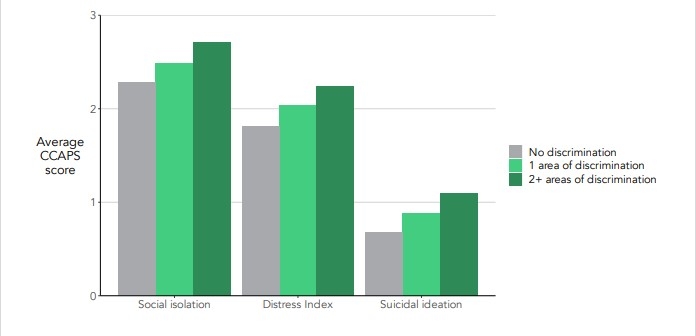
An individual's identity can impact their mental health; this chart indicates how much discrimination someone's identities are facing and the corresponding level of social isolation, distress, and suicidal ideation. The more identities an individual holds that experience discrimination, the more likely they are to experience negative impacts.

For identity specific resources, please visit the Hotlines and Resources tab below. 

*For more information, visit the Center for Collegiate Mental Health.

Dc

Each year, September is dedicated as Suicide Prevention and Awareness Month and the JCU Wellness Center holds various events and activities around campus to bring awareness, educate, and lessen the stigma surrounding suicide. For more information about the following events we run each September, please check Inside JCU, @jcu_well on Instagram, or reach out to wellness@jcu.edu with questions. 

  • 1,100 Flag Display - JCU Wellness displays 1,100 white flags on the main quad for one week each September to recognize the 1,100 students who die by suicide each year. Statistics and resources line the the display for additional information and resources. 
  • Suicide Awareness Pledge - JCU students have the opportunity to stop by the LSC Atrium to sign a pledge that states "I am a voice for suicide prevention" and receive various resources. The pledge remains displayed in the atrium for the remainder of the month.
  • QPR Trainings - QPR is a preventive program that teaches three steps anyone can learn to help prevent suicide. Various training are offered throughout the month and all students, staff and faculty are encouraged to attend. Upon completion, QPR certification lasts for 3 years. 
  • Pebbles for Prevention - An interactive activity for students to attend and de-stress while they paint pebbles and then place them around campus with various resources taped onto it. 

Immediate Help: 

  • JCU Counseling Center: 
    • Location: Garden Level, Dolan Hall
    • How to contact: 216-397-4283
    • Hours: Monday-Friday 8:30am-5pm
      • Crisis Counseling Available by Walk-Ins and Phone Call
    • After Hours Crisis Counseling Available 24/7 at 216-397-4283
  • JCU EMS/Police: 216-397-1234
  • Suicide Crisis Lifeline: Call or Text 988
  • Crisis Text Line: 4Hope to 741741

Identity Specific Resources:

  • Trevor Project for LGTBQ+ Individuals: Available 24/7, call or text 212-695-8650 
  • Veterans Crisis Line: Send a text to 838255
  • Trans Lifeline’s Hotline: 877-565-8860
  • Spanish Suicide Crisis Lifeline: Call or Text 988
  • Blackline Hotline for Black, Indigenous, and People of Color: 1 (800) 604-5841

Additional Resources: 

  • The Emily Program - Receive eating disorder treatment from dieticians, therapists, psychiatrists, physicians, and nurses.
  • Psychology Today - Find a local therapist.
  • JCU Care and Support Form - Submit concerns to the JCU CARE Team, in which the team will provide resources and follow-up to the student.